Queens Unlimited — endless Queens practice puzzles
Queens Unlimited is the practice mode. Pick a size from the tab above, pick a difficulty from the pill beside the board, and keep going: no daily limit, no streak to protect, no clock you have to beat. The daily Queens puzzles are a fixed menu — whatever the calendar hands you, three boards or ten. This page is the opposite of that: 8 sizes, 4 difficulties, 32 combinations and 5,423 finished boards in the pool, any of which is one tap away. It is where you drill the technique that keeps costing you the daily.
Every Queens board size, 5×5 to 12×12
- 5×5 Queens puzzles
- 6×6 Queens puzzles
- 7×7 Queens puzzles
- 8×8 Queens puzzles
- 9×9 Queens puzzles
- 10×10 Queens puzzles
- 11×11 Queens puzzles
- 12×12 Queens puzzles
Each size has a page of its own, so a 9×9 Queens puzzle is something you can bookmark and come back to rather than a setting you have to find again. Size changes the texture of a Queens board more than it changes the difficulty. A small grid has few squares and therefore few places to hide: the reasoning is dense, almost every deduction matters, and there is nowhere to make progress by accident. A large grid gives you more regions and more places where an easy first queen is waiting — and more bookkeeping to hold in your head while you look for it.
Which Queens board size to practise
- 5×5 and 6×6 — a whole board in one glance. The best place to learn what a technique looks like, because you can see the entire chain of reasoning at once.
- 7×7 to 9×9 — where most daily Queens puzzles live. If you are here to get faster at the daily rather than to explore, drill this band.
- 10×10 to 12×12 — long boards. The techniques are identical; what changes is stamina and the discipline to mark everything you have ruled out.
Difficulty in Queens is not the same as size
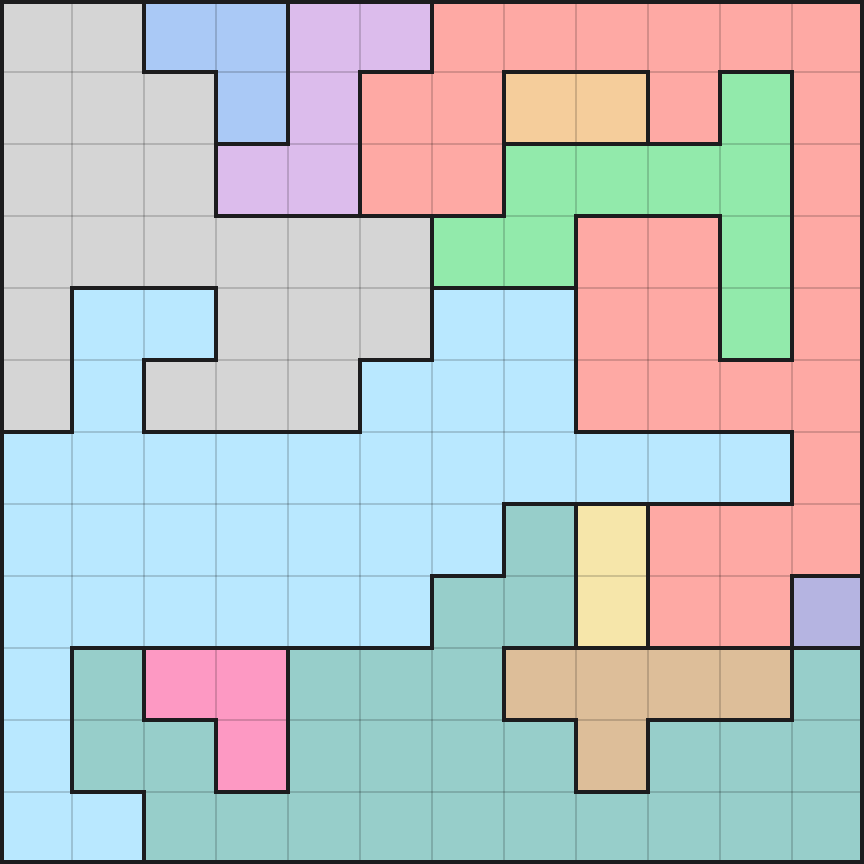
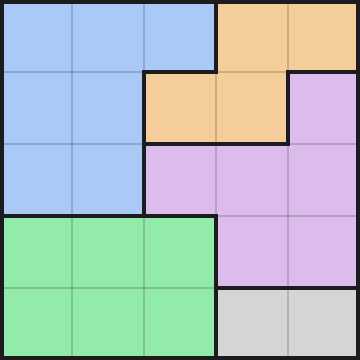
The label describes what a board demands of you. Beginner Queens puzzles give up their first queen to plain counting — some region is already down to one free square, or some row has one candidate left. Hard ones make you prove something about a group of regions together before any single region resolves: count four colours across three rows, conclude that a fifth colour cannot be anywhere in them, and only then place a queen. That is why drilling a small board at hard is better practice than a large one at easy. If your Queens puzzles feel long but never surprising, you have been practising size when you meant to practise difficulty.
What the four Queens difficulty labels mean
- Beginner — opens with a region that already holds a single square, and finishes on counting alone. One free queen is deliberate: without it, the simplest techniques have nothing to bite on from an empty grid.
- Easy — opens on a colour confined to one row or column. It owns that line, everything else in the line is dead, and the board unravels from there.
- Medium — several of those confinements chained together, where each one is only visible after the last has been marked off.
- Hard — pigeonhole arguments spanning several regions at once, plus the exclusion reasoning that rules a square out by showing what it would break.
How to practise Queens without wasting the reps
Unlimited practice Queens puzzles make it easy to play a lot and improve slowly. The difference between volume and practice is whether you chose what you were working on:
- Pick the technique, not the board. Read one page of the strategy guide, then set a size and difficulty and stay there until you can spot that pattern before the hint button can.
- Use hints on purpose. The hint never guesses. It finds the next move a person could justify, fades the board back to the squares that move turns on and names the technique — and waits for you to press show me before marking anything. A hint you asked for deliberately is a worked example, not a failure.
- Cross off what you rule out. The crosses are the working, not decoration. On a 10×10 the deduction you need is usually already on the board and simply not visible until the dead squares are marked.
- Stay in one bucket until it is boring. Boredom is the signal to move up a difficulty. Moving up a size instead just gives you the same reasoning with more squares around it.
Every Queens board here is provably fair
Each puzzle is generated and then checked twice: once for having exactly one solution, and once for being reachable from an empty grid without a single guess. If a board can only be finished by trying something and seeing what breaks, it is thrown away rather than shipped as "hard". The check runs over the entire pool again before every release, so the guarantee covers all 5,423 unlimited practice Queens puzzles behind this page rather than the handful anybody happened to look at.
That guarantee matters more in practice than it does on a daily board. A guess on the daily costs you one puzzle. Here, where the whole point is repeating a kind of position until the pattern is automatic, a board that could only be finished by guessing would be teaching you the wrong habit dozens of times over.
Queens Unlimited and the daily Queens puzzles
Practice and the daily modes are the same engine, the same techniques and the same hint panel. What changes is who picks the board:
- Daily Mini — three Queens boards a day, 6×6 to 8×8, three to six minutes. This is the one that carries a streak.
- Daily Max — ten boards a day climbing to 10×10 and finishing harder than the Mini ever gets.
- Queens Unlimited — this page. Any size, any difficulty, as many boards as you want, and nothing riding on the result.
- Archive — every past day of Queens puzzles, still playable and still scored the same way.
Questions people ask about Queens Unlimited
- Do practice Queens puzzles count towards my streak?
- No. Streaks come from the daily boards; Queens Unlimited is for drilling a technique, so nothing you do here can break a run — or build one.
- What do the difficulty labels mean?
- They describe which ideas you need, not how big the grid is. Beginner boards fall to counting alone; hard boards need pigeonhole arguments across several regions. A 12×12 can be beginner and a 6×6 can be hard.
- Which size and difficulty should I start with?
- 6×6 at easy. It is small enough to hold the whole board in your head and still needs a real technique to open. Move up a difficulty before you move up a size — that is the axis that teaches you something.
- Will I see the same Queens puzzle twice?
- Only if you play a long time. Every size and difficulty has its own pool — dozens of boards in the thinnest bucket, a few hundred in most — and the picker avoids repeats within a session.
- Is there a limit?
- No. Solve one, take another. The only thing the daily modes have that Queens Unlimited does not is a streak.
- Is Queens Unlimited free, and do I need an account?
- Free, and no. There is nothing to install and nothing to sign up for. Your board, your clock and your hint count are stored on your device, and a refresh brings all three back exactly as you left them.
- Can I play these Queens puzzles on a phone?
- Yes. The board sizes itself to the screen, so even a 12×12 stays tappable one-handed. If colour is not a reliable channel for you, turn on high-contrast colours in Settings and the regions separate by lightness instead of hue.