Daily Max Queens Game — ten Queens boards a day
The Daily Max is the long version of the Queens game: ten boards in one run, climbing from 6×6 to 10×10 and from beginner counting to techniques the Daily Mini never asks for. Same rules as every Queens puzzle — one queen per row, one per column, one per colour, no two touching — and the same board you already know how to tap. What changes is how long the Queens game keeps resisting. Most people take around twenty minutes, and your place is saved between levels, so you can stop at level four and come back after dinner.
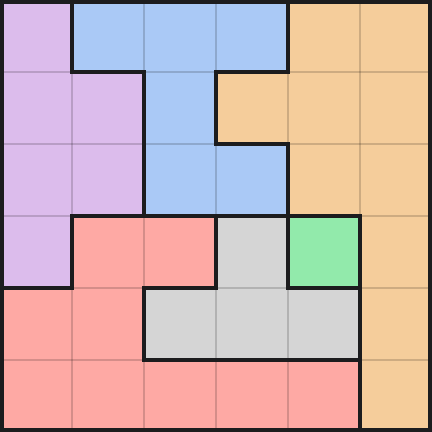
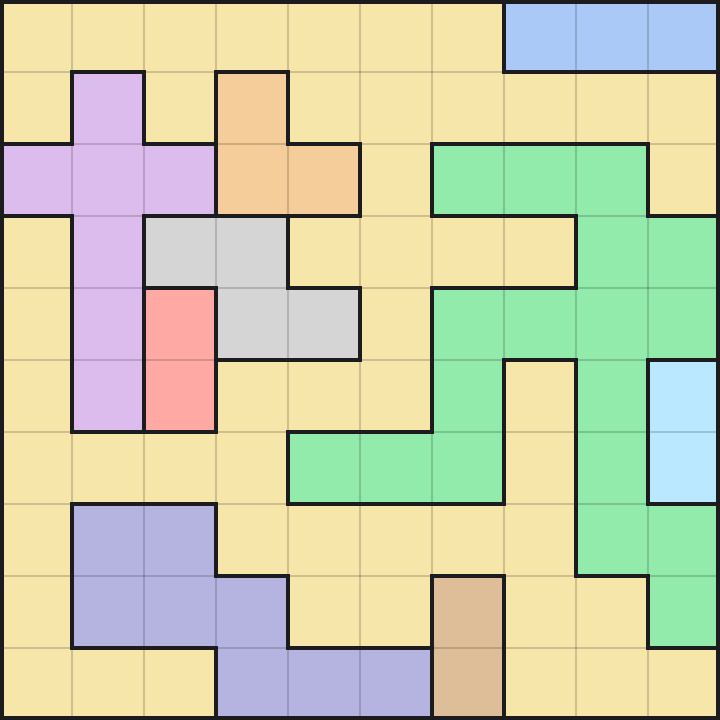
The ten levels of the Daily Max Queens game
Two boards at every size, the second harder than the first, and the difficulty climbs faster than the grid does. That shape is deliberate: a Queens game that only grew wider would just take longer, so each size arrives twice — once to get your eye in, once to make you work.
- 6×6 Beginner
- 6×6 Easy
- 7×7 Easy
- 7×7 Medium
- 8×8 Easy
- 8×8 Medium
- 9×9 Medium
- 9×9 Hard
- 10×10 Medium
- 10×10 Hard
Levels one to four are the warm-up: the first board hands over a queen almost immediately, and everything through the 7×7 pair falls to counting and crossing off. Levels five to eight are the middle of the Queens game, where a board opens on a colour trapped inside one line rather than a colour down to one square. Levels nine and ten are the reason the run exists.
Queens game rules, in four lines
- Exactly one queen in every row.
- Exactly one queen in every column.
- Exactly one queen in every coloured region.
- No two queens may touch — side by side, stacked, or diagonally.
A 10×10 board therefore takes 10 queens, because it holds 10 colours. Nothing along the way is penalised: place a queen, change your mind, take it back. The clock runs, but the clock is yours to ignore.
Controls
- Tap once — cross a square off, to record what you have ruled out.
- Tap twice — place a queen.
- Tap a third time — clear the square.
- Press and drag — cross off a whole run of squares at once.
- Arrow keys — move around the board; Space or Enter cycles a square.
Placing a queen crosses off everything she attacks, so the board does the bookkeeping and you do the reasoning. Turn that off in Settings if you would rather mark by hand — on the late levels some people prefer it, because marking the consequences yourself is how you notice them.
What makes the last Queens boards hard
Not size. A 10×10 with generous regions falls to plain counting, and a 6×6 can take ten minutes. What changes is which argument you need. The last boards of the Queens game are built so that no row, column or colour is ever down to its final square until you have first proved something about a group of regions together — count three colours across two rows, conclude that a fourth colour cannot be anywhere in them, and only then place a queen. That step is what separates a hard board from a big one.
The techniques the last two levels need
- Simple undercounting — two colours that fit in only two rows fill those rows completely, so every other colour leaves. The first properly hard technique in the Queens game, and the one level nine usually turns on.
- The rule of crowding — the same count run the other way: three rows that can only be served by three colours own those colours outright.
- The rule of clumps — queens in touching rows need two columns of clearance, which quietly kills options that look fine in isolation.
- Exclusion logic — the last resort, and still not guessing: try a square, push the easy logic two steps, and rule it out when the board falls apart.
All ten are written up in the strategy guide, in the order the solver prefers them. The hint button uses the same order, which is why a hint on level ten is worth reading even when you were about to find the move anyway.
How to get through ten Queens boards without stalling
The failure mode on a long run is not a board you cannot solve. It is a board where you stop making marks and start staring, and the twenty-minute run becomes forty.
- Open on the smallest region. A colour occupying one or two squares gives up its queen almost immediately, and every queen you place crosses off a dozen more squares.
- Count lines, not squares. If a row has two candidates left, work there. Process of elimination beats scanning, and on a 10×10 it beats it by a lot.
- Mark everything you rule out. Crosses are the working, not decoration. On the late levels the deduction you need is usually already on the board and simply invisible until the dead squares are marked.
- Take the hint on level nine. A hint you asked for deliberately is a worked example: the board fades back to just the squares the next move turns on, the reason is spelled out in a sentence, and the technique links to the page in the strategy guide that explains it. Nothing is marked until you ask for it.
Every Queens game board here is provably fair
Each of the ten boards is generated and then checked twice: once for having exactly one solution, and once for being reachable from an empty grid without a single guess. A board that can only be finished by trying something and seeing what breaks is treated as a bug, not as a hard puzzle, and never ships. The check runs again over the whole calendar before every release.
That guarantee is what makes a ten-board run worth doing. On a single daily puzzle a guess costs you one board; over ten, a Queens game that quietly required guessing would waste twenty minutes and teach you nothing about why you were stuck.
Daily Max and the other Queens game modes
Every mode is the same engine, the same techniques and the same hint panel. What changes is how many boards you get and who picks them:
- Daily Mini — three boards, 6×6 to 8×8, three to six minutes. The short daily Queens game, and the one most people start with.
- Daily Max — this page. Ten boards climbing to 10×10, finishing harder than the Mini ever gets.
- Unlimited — practice boards from 5×5 to 12×12 at four difficulties with no daily limit, for drilling the technique that keeps costing you the run.
- Archive — every past day of the Queens game, still playable, still scored the same way.
Nothing here sits behind a login, a paywall or an install. Your board, your clock and your hint count live on your device, and a refresh brings all three back exactly as you left them — mid-run, on level seven, with the crosses still where you put them.
Questions people ask about the Daily Max Queens game
- How long does the Daily Max Queens game take?
- Around twenty minutes for the full ten boards once the reasoning is familiar. Your first week will be longer — the early levels get quick long before the late ones do.
- How is Max different from the Daily Mini?
- Ten boards instead of three, climbing from 6×6 to 10×10 and from beginner logic to techniques you will not find by staring. The Daily Mini is a coffee break; Max is the long version of the same Queens game.
- Do I have to finish it in one sitting?
- No. Your progress through the ten levels is saved as you go, so you can leave after level four and pick it up that evening.
- Does using hints break my streak?
- No. Finishing the run is what counts. Hints are recorded separately so you can watch that number fall over the weeks.
- Which levels are the hard ones?
- The last two. Everything before them can be finished with counting and elimination; the final pair need a pigeonhole argument across several regions at once.
- Is the Daily Max Queens game free?
- Yes, and there is no account to make and nothing to install. Open the page and today’s first board is already on screen.
- Can I play the Daily Max on a phone?
- Yes. The board sizes itself to the screen, so a 10×10 stays tappable one-handed. If colour is not a reliable channel for you, turn on high-contrast colours in Settings and the regions separate by lightness instead of hue.
- What if I miss a day?
- The run is still there. Every past day of the Queens game stays playable in the archive, scored the same way it was on the day it published.